
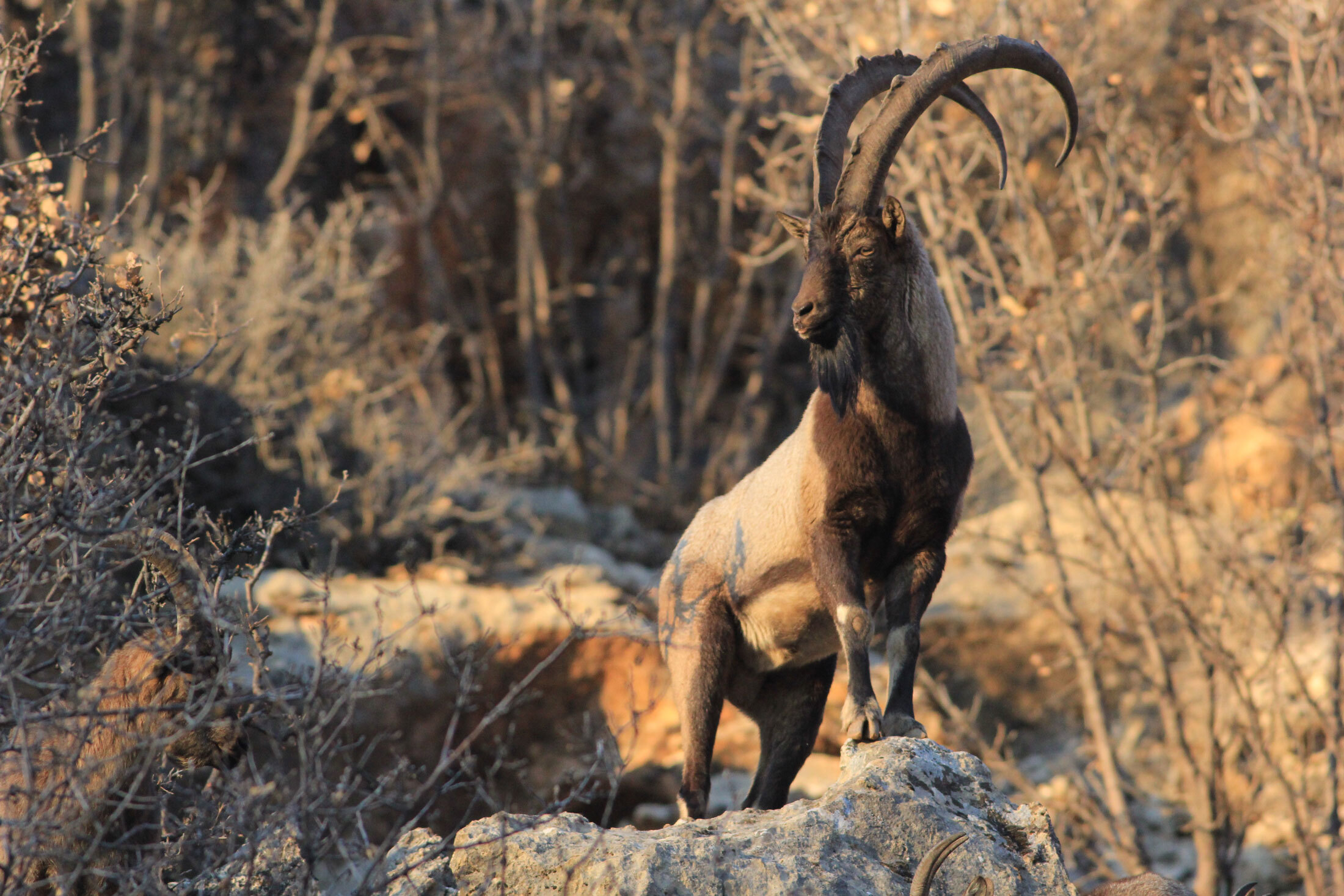





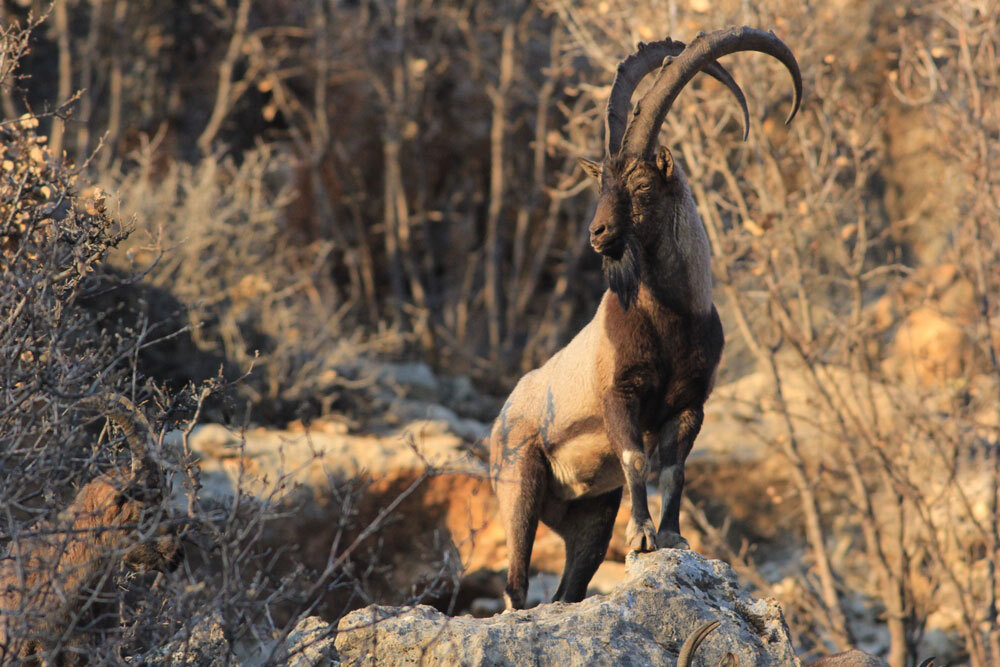
The Kri Kri ibex (Capra aegagrus cretica)—also called the Cretan wild goat or agrimi—is the smallest of all wild goats. Males are slender with a reddish‑brown summer coat marked by a dark dorsal stripe, shoulder and flank stripes, and white underparts; in winter, the coat turns ashy grey. Large scimitar‑shaped horns with widely spaced knobs sweep back over the shoulders and can exceed 1.15 m (45 in) in exceptional rams. Females are much smaller with shorter, smoother horns and may lack the dark markings. The species’ limited range on a few Greek islands and its impressive horn length make the Kri Kri a coveted European trophy.
Kri Kri hunts are strictly controlled by the Greek forestry authority and take place on uninhabited islands such as Atalanti and Sapientza, and in a few mainland reserves. Seasons are short—late October to early December on Atalanti, November to early December on Sapientza and September to late October/early November on the mainland. Only shotguns loaded with slugs may be used; rifles and bows are prohibited. Hunters travel by boat to the islands and then stalk or still‑hunt through maquis and rocky hillsides; because populations are small, licences are limited and hunts may be rescheduled due to weather or animal numbers. On the mainland and in neighbouring North Macedonia, a handful of permits are issued each year, with the best hair quality from October through mid‑April.
Pure Kri Kri ibex herds survive only on Sapientza and Atalanti islands and in a few fenced reserves, with other mainland populations derived from translocations and often hybridised with feral goats. The Greek forestry service (Dasarheo) decides annually whether hunting will take place based on population surveys and health assessments. Regulated hunts generate revenue for local communities and incentivise protection of the islands, which are otherwise closed to grazing and development. Cross‑breeding with domestic goats and limited genetic diversity remain conservation concerns, so maintaining pure stocks is a priority.
Despite their small body size, Kri Kri rams grow remarkably long horns, and trophies exceeding 75 cm earn “gold medal” status. Males develop calloused pads on their knees and sometimes their chests, an adaptation to fighting and negotiating sharp rocks. Because the islands are uninhabited and used solely for wildlife management, hunts often feel like a Mediterranean adventure, combining boat travel with stalking and sightseeing. In local folklore, the Kri Kri symbolises freedom and resilience, having survived millennia of human settlement on Crete.
Kri Kri Ibex can be found in the following location:
Kri Kri Ibex has the following variations:
- (Varieties to be confirmed)
Start Your Adventure